
Stage 10. Cookie vs Session vs JWT
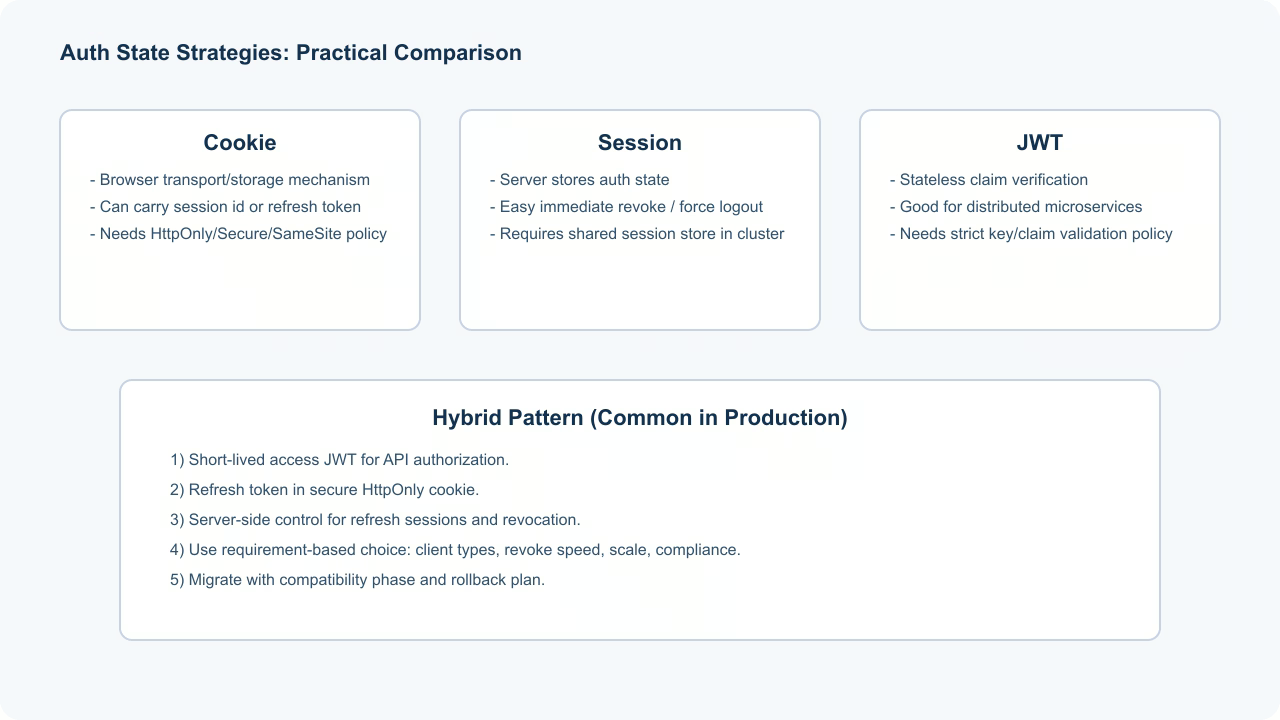
The debate cookie vs session vs JWT is often framed incorrectly because these belong to different abstraction layers. Cookie is a browser delivery/storage mechanism. Session is a server-side stateful auth model. JWT is a signed stateless claim format. So the real engineering question is which combination best matches product requirements.
1. Role of Each Mechanism
Cookie handles browser transport. It may carry a session id, refresh token, or another technical marker. Session keeps auth state on server and gives centralized control. JWT allows services to validate claims locally without per-request session lookup.
Core takeaway: cookie usually does not compete with JWT directly; they are often used together.
2. Where Session Is Stronger
Session is strong when you need:
- Immediate access revocation.
- Central visibility of active user logins.
- Predictable forced logout behavior.
- Straightforward server-side audit trails.
This is practical for admin consoles, employee portals, and finance interfaces where control is more important than pure stateless scale.
3. Where JWT Is Stronger
JWT is strong when:
- Many APIs/microservices must validate tokens independently.
- Stateless authorization checks are performance-critical.
- Team has mature key and claim governance.
The cost is harder revocation, strict token lifetime policy, and the need for consistent validation across all services.
4. Comparison by Practical Criteria
| Criterion | Session | JWT |
|---|---|---|
| Immediate revoke | Strong | Needs extra mechanisms |
| Many-service scale | Requires shared store | Strong |
| Ops complexity | Store + cookie policy | Key rotation + strict validation |
| Risk of inconsistent auth behavior | Lower | Higher without shared policy |
Cookie in this comparison is a transport layer and must be configured separately (HttpOnly, Secure, SameSite, Domain, Path).
5. Why Hybrid Is Often Best
A common production pattern is:
- short-lived access JWT for APIs;
- refresh token in secure HttpOnly cookie;
- server-side refresh-session control and revocation.
This gives balanced performance, control, and UX across browser and mobile clients.
6. Mandatory Inputs Before Choosing
- Client types: browser, mobile, machine-to-machine.
- Revoke speed requirement (seconds vs minutes).
- Team operational maturity: session store, key rotation, runbooks.
- Migration plan with compatibility phase and rollback.
- Auth observability metrics and alerts.
Without these inputs, teams choose by trend instead of engineering constraints.
Practical scenario
A team tried a one-release migration from session-based auth to JWT for both web and mobile. Web behavior depended on cookie flows while mobile expected a different refresh lifecycle. Result: repeated logins and unstable 401 spikes after release. After switching to staged migration, adopting a hybrid model, and defining clear TTL/revoke rules with an auth incident runbook, reliability recovered. The lesson is practical: the best model is not the most fashionable one, but the one your team can operate safely every day.